LANSING – Attorney General Mike Cox urged the Michigan Legislature to reject efforts by Detroit Edison and Consumers Energy to eliminate electric customer choice in the name of additional capacity. He said efforts to impose a renewable portfolio standard should be sold as an effort to help the environment, not the economy.
Whatever the goals of the proposal being discussed in the House, the outcome is going to be annual rate increases of as much as 40 percent, Cox said. His position was blasted by Governor Jennifer Granholm’s spokesperson and a top House Democrat. In fact, Mr. Cox’s position was tabbed as a “jobs killer” by the administration.
Cox’s comments were ridiculed as full of error by Rep. Frank Accavitti (D-Eastpointe).
But Cox said: “What we have being contemplated right now is a rate increase of $2.1 to $2.8 billion imposed by government.”
Much of that increase, Cox said, will be the result of the proposed renewable portfolio, which Granholm has proposed by 10 percent by 2015 and 25 percent by 2025.
Cox said that RPS would increase rates by $1 billion a year.
“States that go to an RPS, their rates jump,” he said.
Cox did not directly oppose implementing an RPS, but he said if it is to be done, it should be through the lowest-cost method possible. In addition to allowing the utilities to build their own renewable power, he said the RPS needs to allow utilities to purchase power, or renewable credits, from alternative providers both in Michigan and in other states.
To further hold down the cost, he said rates should not be allowed to increase more than 2 percent above what they would be without including renewable power in the rates.
He also argued that the RPS should not be sold as an economic development tool. Though a number of renewable energy companies have argued to legislative committees that they are looking to invest in states with an RPS, Cox questioned why the 24 states that have already implemented an RPS have not seen more investment.
“We’re loading it up with Christmas lights to say it’s something other than it is,” he said. “I hope they come here but we shouldn’t tell the public all these companies are going to come here because we do an RPS.”
Cox said electric customers in the state should continue to have choice if there are cheaper providers than the utilities.
“Why do you want to take that option away from all Michigan businesses to help two?” he said.
He argued the 10 percent cap on customers choosing an alternative provider was little better than eliminating choice.
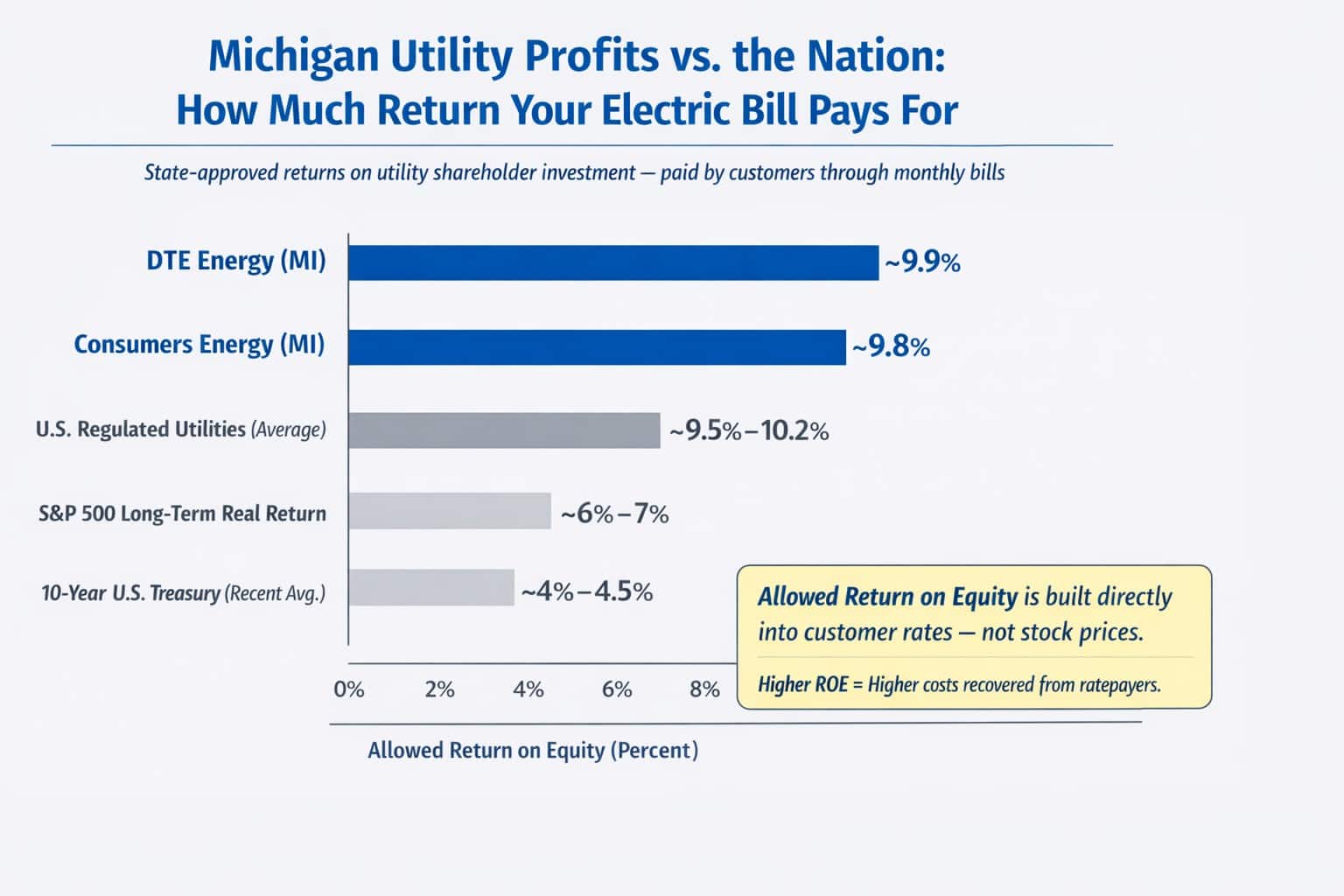
Cox argued that the package as written is designed to increase profits for the two major utilities. “The more assets they have, the more rate of return they have,” he said. “Right now as it’s written all the incentives are the big utilities build and we’ll pay you to build.”
He said both the file and use provision for rate increases and the certificate of need proposal for new generation were essentially ways for the utilities to borrow form ratepayers.
“That’s not the way to go and that’s not protective of consumers,” he said of the file and use rates.
On rate deskewing, ensuring that customer rates are based on their actual cost of service, Cox argued that should be left to the Public Service Commission, which has been adjusting rates recently to remove the subsidy residential ratepayers now enjoy at the expense of commercial and industrial customers.
Cox said he has had staff involved in the discussions on the issue in the House, but so far mostly to review the legal implications of any proposals discussed. “I don’t know if we’ll be invited back after today,” he said.
“The inaccuracies the attorney general is purporting – you could drive a bus through,” said Accavitti.
Accavitti, chair of the House Energy and Technology Committee and a lead negotiator on the package, said the legislation is about creating jobs in the state and providing a comprehensive and long-term energy strategy that will stabilize rates compared to if policymakers sat back and did nothing.
The attorney general has had a chance to provide input to the plan by having a representative attend the last two energy workgroup meetings, Accavitti said, but so far, that person hasn’t contributed anything to the debate.
Liz Boyd, Granholm’s spokesperson, said the governor had proposed an energy plan that would both grow the state’s economy and help preserve the environment. What Cox proposes is a “jobs killer,” she said.
This story was provided by Gongwer News Service. To subscribe, click on Gongwer.Com
a>>