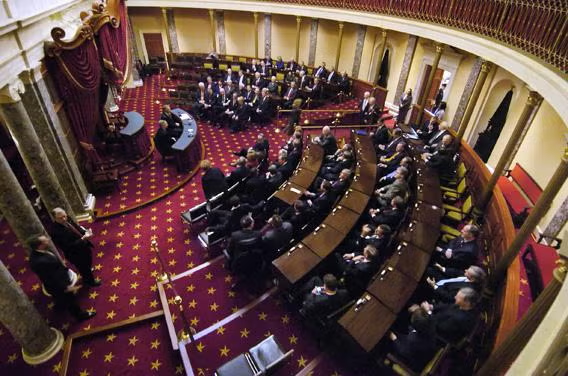
LANSING – Both the Michigan House and the Senate are expected to take action on a package of bills that would allow the Michigan Economic Development Corporation to streamline all of its reporting requirements on the 21st Century Jobs Fund into one report and increase the amount of community revitalization projects it authorizes.
Currently, House legislation (HB 4480 , HB 4481 and HB 4482 ) awaits action in the Senate and Senate legislation (SB 269 , SB 270 , SB 271 and SB 273 ) awaits action in the House. The House is expected to take up the Senate bills in the first week of lame duck, sources said Thursday, and the Senate will almost simultaneously move the House bills.
The Senate bills were reported from a House committee, while the House bills were only recently transmitted to the Senate last week.
What is known as the 21st Century Jobs Fund today was created in 2005 under the direction of former Governor Jennifer Granholm. In the current fiscal year, $75 million is divvied up in three parts: $29 million to fund the state’s tourism campaign, Pure Michigan, exclusively for advertising (those working for Pure Michigan are funded through a different line item); $21 million for business developments and community revitalization projects; and $25 million for entrepreneurship and venture capitalist-type loans.
“These are three critical areas and we’re hoping to get this legislation finalized at the end of the year,” said James McBryde, vice president and senior advisor at the MEDC.
There is not expected to be any significant change to those amounts, and especially not through the bills at hand (the money is appropriated during each new budget) despite that the Pure Michigan campaign and those involved with it have been asking for more money every year to expand their reach internationally and strengthen the brand domestically.
But the bills will make some small modifications to allow for more flexibility in the current MEDC operations.
The primary purpose of SB 269 is to extend the current sunset to 2019.
Streamlining the reporting requirements for the program comes in HB 4480. Currently, the MEDC must submit about 22 reports annually, including two reports about six months apart for the same program asking for largely the same information, McBryde said.
“We think it would be much more transparent and much more helpful,” McBryde said.
Numerous changes to the community revitalization program are outlined in SB 271. There is currently a $1 million cap on community revitalization grants, and a Senate Fiscal Agency analysis of the bill from last year says that jumps to $2.5 million. But the MEDC said it will only increase to $1.5 million. Because the MEDC cannot provide a grant of more than 25 percent of the total, the increased base would allow it to help projects up to $6 million.
“The $1 million cap is not enough to some of the projects we need to with some of our inner cities,” McBryde said. “… This gives us the ability to do more, larger projects.”
SB 272 creates an advisory committee to make recommendations regarding projects relating to port facilities.
“We currently do not have the expertise at the MEDC to advise us on port-related developments,” McBryde said. “We would be excited to a project if we had the expertise.”
This story was provided by Gongwer News Service. To subscribe, click on Gongwer.Com