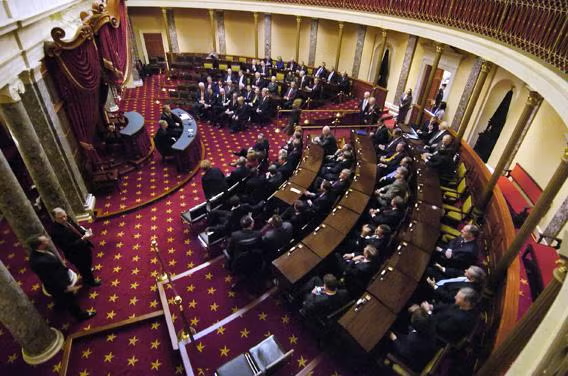
LANSING – After a bill from last session that would allow law enforcement to obtain location information from wireless carriers without a court order in certain emergency situations failed to reach the full chamber, the House Criminal Justice Committee is again taking up the legislation.
Rep. Kurt Heise (R-Plymouth Township), chair of the committee and sponsor of HB 4006 , said during Tuesday’s committee hearing the bill is named the “Kelsey Smith Law” after a Missouri woman was abducted and later found raped and murdered after a wireless carrier provided law enforcement with cell phone information.
When law enforcement officials were looking for Smith, they tried for several days to get the location information, and found her body within an hour after receiving the information.
“Bottom line is what this bill would do is it allows law enforcement, without a warrant or without judicial approval, the ability to ping your cell phone to locate your whereabouts or at least your last known cellular phone transmission,” Heise told the committee. “In an emergency situation, it is not always possible to find a judge to do a search warrant or to issue an order to obtain this type of information.”
Heise said the bill met some opposition from a former member of the committee last term worried about law enforcement abuse. During a hearing about a year ago, Rep. Ed McBroom (R-Vulcan) questioned what would prevent an abusive spouse from using the police to locate the other spouse who had run away.
The bill would make it a misdemeanor punishable by 93 days in jail or a fine up to $500 for law enforcement who abuse the system. Heise said this would be on top of how the agency would choose to punish the official.
McBroom is no longer on the committee. The bill received little discussion as the meeting was the first of the session and designated mostly for organizational matters.
Heise said the bill may come up again next week, depending on how receptive committee members are to the legislation.
Rep. Peter Lucido (R-Shelby Township) questioned the cost of the legislation, saying wireless carriers would likely charge for providing the information.
Heise said he expected the costs to be minimal. A House Fiscal Agency analysis said local correctional systems costs might increase and the Department of State Police might see a nominal fiscal impact because the department would be required to obtain contact information for carriers and disseminate that information to local law enforcement agencies.
The bill would also provide immunity to the wireless carriers that comply with the requests from law enforcement.
This story was provided by Gongwer News Service. To subscribe, click on Gongwer.Com