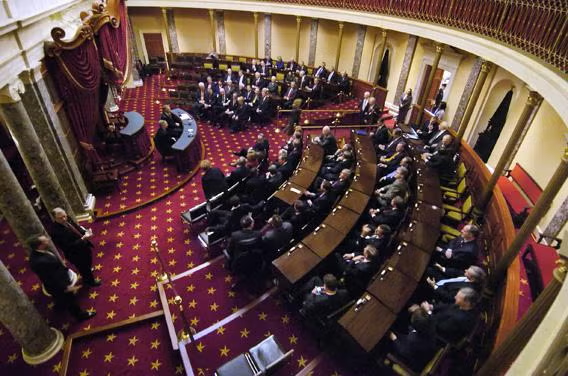
LANSING – The Michigan Senate on Wednesday swiftly passed a bill that would eliminate a 2017 sunset on funding for the film incentive program as well as revise caps starting in 2015.
The bill, SB 1103 , heard testimony in the Senate Economic Development Committee on Wednesday morning, largely in support of its provisions. The committee reported the bill with an S-1 substitute, but the Senate later defeated that substitute on the floor in place of an S-2 substitute and added a technical amendment.
“This bill amends the film incentive program … by encouraging long-term commitment to the state,” Sen. Mike Kowall (R-White Lake Township) said on the Senate floor. “This legislation will simplify the incentive program by eliminating tiers and provide for flat rates.”
The final bill cleared the chamber on a 32-4 vote, with Sen. Patrick Colbeck (R-Canton Township), Sen. John Moolenaar (R-Midland), Sen. Joe Hune (R-Whitmore Lake) and Sen. Dave Robertson (R-Grand Blanc) in opposition to the bill. Senate Minority Leader Gretchen Whitmer (D-East Lansing) was absent at the time of voting and Sen. Mike Nofs (R-Battle Creek) was absent from session.
As passed by the Senate, the bill modifies the Film and Digital Media Production Assistance Program operated by the Michigan Film Office. That program, per the Senate-passed bill, may provide funds to eligible companies for direct production expenditures or qualified personnel expenditures for state-certified qualified productions, though it removes Michigan-specific language on personnel and crew personnel expenditures.
For state-certified qualified production expenditures after December 1, 2014, an agreement shall provide for funding equal to the sum of 25 percent (previously 27 percent) of direct production expenditures as well as qualified personnel expenditures, and 3 percent of direct production expenditures and qualified personnel expenditures at a qualified facility, or 10 percent of the direct production and qualified personnel expenditures at a post-production facility for qualified productions.
The bill also expands the number of seasons that a television show may submit an application from no more than two successive seasons to one or more successive seasons.
And no less than 10 percent of the funding awarded under certain provisions of the proposal is to be awarded for qualified productions that are motion pictures, documentaries or television series with a budget of less than $15 million. Also contained within the bill is a section requiring the payment of Michigan income tax on residual, a staffer for the bill sponsor, Senate Majority Leader Randy Richardville (R-Monroe) said at the committee meeting.
Funding for above-the-line personnel, such as actors, directors and writers, is not to exceed 30 percent of the total funding for each qualified production, the bill states. But to be eligible for funding, Michigan residents are to be hired to work at a ratio of not less than one resident for every nonresident hired through September 30, 2017; not less than 1.5 residents for every one nonresident through October 1, 2018; and no less than two Michigan residents for every nonresident beginning October 1, 2020. That again expands to no less than three Michigan residents for every nonresident hired beginning October 1, 2022.
“This bill is good for the state of Michigan and the workers,” said Patrick Dougherty, secretary of treasury for a teamsters group in Detroit. “It will allow productions and workers to train more Michigan workers.”
And Richardville has said from the get-go that that is the intent of the bill. He said there are qualified residents to handle these jobs now, but the universities are churning out even more, so the availability of those workers should grow as time passes and programs become more well-known for their graduates’ work.
Joseph Scott Anthony, president of the Media Arts Coalition of West Michigan, also gave the committee several examples of some Grand Rapids-area people who have gone from small but award-winning indie films to big-time productions with big-name stars.
“It’s been an awesome few years,” Anthony said. “We have people that were born here … that have the possibility of moving all the way up the chain from beginning local films to (multi-million dollar) films like Oz.”
This story was provided by Gongwer News Service. To subscribe, click on Gongwer.Com