LANSING – Senate Majority Leader Randy Richardville on Thursday picked up support from a majority of both his caucus and minority Democrats to repeal the current minimum wage law and replace it with a measure that would gradually increase the minimum wage to $9.20 an hour by January 1, 2017, and tie to inflation going forward.
It was a stunning turn of events from a week ago when Richardville (R-Monroe) introduced the bill, which in its original form called for an increase from $7.40 an hour only to $8.15 with no inflation escalator and whose main purpose appeared designed to undercut the ballot proposal that would raise the minimum wage to $10.10 an hour, even for tipped workers now at $2.65 an hour.
Democrats denounced that bill as a bit of trickery – it could negate the ballot proposal by repealing the law the proposal would amend – but with all the changes made Thursday, 10 of their 12 members voted for it and then Democratic gubernatorial candidate Mark Schauer made a surprise appearance on the Senate floor afterward to praise the action.
“I feel real proud of the legislation and the fact that people worked together to get this done,” Richardville told reporters after session. “Everybody gained a little bit here and everybody lost a little bit here, but I think it was good legislation.”
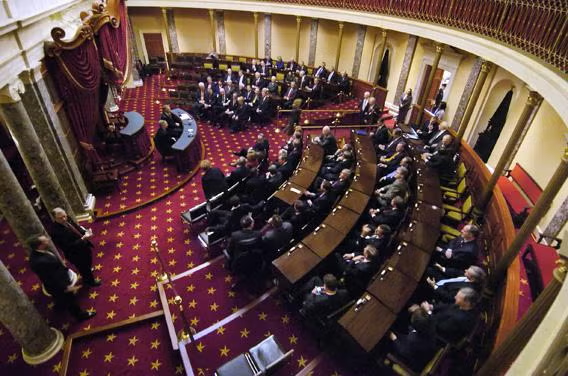
Indeed, SB 934 left the Senate on a 24-14 vote with two amendments in addition to the adoption of an S-7 substitute, one from Senate Majority Floor Leader Arlan Meekhof (R-West Olive) and the other from Senate Minority Leader Gretchen Whitmer (D-East Lansing).
Meekhof’s amendment caps the Consumer Price Index factor now contained within the bill at inflation or 4 percent, whichever is less. After a few minutes on the board, the amendment picked up 21 votes of support on an unrecorded vote.
Whitmer’s amendment added back language that was in Richardville’s original bill, she said, which states that the minimum hourly wage for an employee who is less than 18 years of age is 85 percent of the general minimum hourly wage established within the bill. That amendment dumped a move to let businesses continue paying those under 18 $7.40 an hour.
Under the S-7 version adopted by the Senate, the minimum wage would increase to 8.15 an hour in September; to $8.50 on January 1, 2015; to $8.85 on January 1, 2016; and to $9.20 on January 1, 2017.
Tipped workers also saw an increase greater than that which was proposed. Those workers would go from $2.65 an hour to $3.10 an hour in September (originally it was $2.93); $3.23 on January 1, 2015; $3.36 on January 1, 2016; and $3.50 on January 1, 2017./P>
Richardville said the tipped workers difference was important “for some people.”
“I don’t think the people circulating petitions understood how devastating that would be to the restaurant industry,” he said. “It wouldn’t have helped them, because they would have had those jobs eliminated.”
Richardville said the backers of the ballot proposal certainly raised the awareness of the senators on the issue, and that was part of how everything came together.
“While they may have been well-intentioned, I think they went way too far. The language was not good language. It didn’t address things and it wasn’t something that we could change or amend, so instead what we did was replace it,” he said. “I think what we came up with was a far better answer to the question than what was being proposed. So we worked with the other side of the aisle, we worked within our caucus, we got bipartisan support.”
Sen. Rick Jones (R-Grand Ledge) noted in a statement after the bill passed that the difference for tipped workers was a point of interest for him.
“If we hadn’t done that, thousands across the state would have lost their jobs, probably hundreds of restaurants would’ve closed,” Jones said, adding that he also appreciated the inclusion of language outlined in Whitmer’s amendment.
The two Democrats voting no were Sen. Morris Hood III of Detroit and Sen. Coleman Young II of Detroit.
The 12 Republicans who voted yes, in addition to Jones and Richardville, were Sen. Darwin Booher of Evart, Sen. Jack Brandenburg of Harrison Township, Sen. Tom Casperson of Escanaba, Sen. Bruce Caswell of Hillsdale, Sen. Roger Kahn of Saginaw Township, Sen. Mike Kowall of White Lake township, Mr. Meekhof, Sen. Mike Nofs of Battle Creek, Sen. John Pappageorge of Troy, Sen. Dave Robertson of Grand Blanc, Sen. Tory Rocca of Sterling Heights and Sen. Howard Walker of Traverse City.
The 12 Republicans who voted no were Sen. Patrick Colbeck (R-Canton Township), Sen. Judy Emmons (R-Sheridan), Sen. Mike Green (R-Mayville), Sen. Goeff Hansen (R-Hart), Sen. Dave Hildenbrand (R-Lowell), Sen. Joe Hune (R-Whitmore Lake), Sen. Mark Jansen (R-Gaines Township), Sen. Jim Marleau (R-Lake Orion), Sen. John Moolenaar (R-Midland), Sen. Phil Pavlov (R-St. Clair), Sen. John Proos (R-St. Joseph) and Sen. Tonya Schuitmaker (R-Lawton), and Sen. Coleman Young II.
Colbeck said he was “disappointed” the Senate passed the bill.
“Every time you jack up the minimum wage, you decrease the rate of employment,” he said. “This is bad news for the state of Michigan.”
But the two Democrats voting in opposition had a different take on why they did not agree with it.
“Even though this is a raise in the minimum wage that we sorely need, this legislation still tramples on the rights of the people by taking away their ability to have a ballot initiative brought forth,” Hood said. “I support the increase, but for that simple matter of not having the people be able to do an initiative, I voted no.”
On the other side of the spectrum, Sen. Bert Johnson (D-Highland Park) said he too still had some concerns about the manner in which the raise was achieved, but he said he could support the bill because of “crucial improvements” that were made to it on the floor.
“It’s not the exact solution I was looking for or that I wanted when I introduced a bill over two years ago, but given the circumstances and the politics, I feel compelled that my yes vote is in fact in the interest of Michigan workers who literally just can’t afford to wait,” Johnson said. “This bill may not go as far as a lot of us would want it to, but after the improvements that my Democratic colleagues and I have secured, I am confident that its passage will mean real relief for Michigan’s families in the short-term and the long-term.”
Also contained within the bill is a provision stating that every October, beginning in October 2017, the wage and hours division of the Department of Licensing and Regulatory Affairs shall calculate an adjusted minimum wage rate based on the consumer price index. Meekhof tried to win an amendment to remove this provision, but it was defeated on an unrecorded vote.
The CPI provision is something of a double-edged sword for Republicans. On the one hand, it means automatic annual wage increases for their allies in the business community to pay, but on the other, the Legislature may never have to deal with the issue again, as Richardville acknowledged. Democrats have clubbed Republicans on the minimum wage for years.
“I think a lot of businesses can plan out to the future. … We addressed it with CPI, which means basically we think we’ve addressed this maybe for the long-term, maybe forever,” he said. “But that’s probably too far.”
This story was provided by Gongwer News Service. To subscribe, click on Gongwer.Com