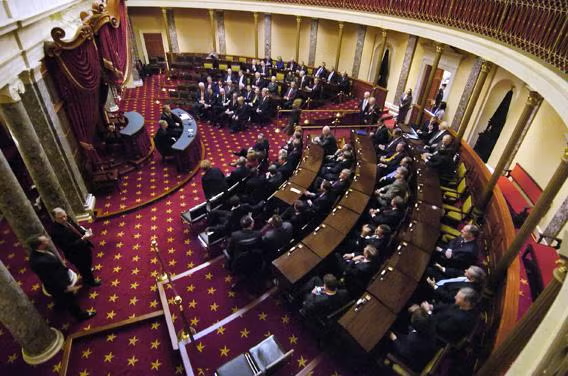
LANSING ? Michigan Senate Majority Leader Arlan Meekhof said Friday the state should be out of the pension business when it comes to the Michigan Public School Employees Retirement System, essentially advocating for not only new hires but everyone in the system to have a defined contribution 401(k) account instead.
Meekhof’s comments, coming a day after majority House Republicans made ending pensions for new teachers one of their priority action items this term, underlined that the existing hybrid system of giving new teachers some 401(k) and some pension benefit through is going to be a major issue for the 98th Legislature.
“If we can find a way to move everybody over there, it makes the most sense,” Meekhof (R-West Olive) told Gongwer News Service in a phone interview. “I think a lot are making those decisions already.”
The idea of switching over to a 401(k)-type system has been bandied about in the last several years, and as recently as December when Republican former Sen. Mark Jansen introduced legislation to do just that, among other changes to MPSERS. Meekhof was a sponsor of one of the bills.
But the full switch didn’t get much support when the Legislature reworked the MPSERS system in 2012. The administration of Governor Rick Snyder opposed the change. New hires can choose either a hybrid plan that provides some pension and some defined contribution benefits, or have strictly defined contributions.
“I think it’s a better tool for them to manage their own retirement,” Meekhof said. “A lot of folks could be retired longer than they work. We’re already moving in that direction, but we have to find a way to give folks under pensions a better way to manage their retirement.”
One of the biggest issues with a strictly defined contribution system has been the cost. A 2012 report concluded that if public school employees were to be provided the same defined contribution plan as state employees receive, the added cost would be $13.6 billion over 30 years.
“It’s something we need to understand the total cost. I realize it’s going to be expensive,” Meekhof said. “But it’s not unprecedented.”
Rep. Earl Poleski (R-Jackson), who will likely be heavily involved in this issue as it evolves, said it will take a considerable amount of time and analysis before this type of change can be made.
However, he said, if there was a Legislature that could make the change, it’s in session now.
“I think what you saw with the action plan yesterday is an inclination to boldness and try to do heavy lifts,” Poleski said, referencing the action items unveiled by Cotter.
But the Michigan Education Association said making this kind of switch does nothing to help attract talent to the teaching field, especially considering some provisions of current law, like the lack of retiree health insurance for new hires (that was replaced with a 401(k) or 457 plan that includes an employer match of up to 2 percent of compensation plus a lump sum deposit of either $1,000 or $2,000 upon termination of employment).
“We’re making it more and more difficult to attract the best and brightest to the profession by attacking their benefits (and) wages,” said David Crim, MEA communications consultant. “This would go along with that.”
Poleski said another option would be to move all teachers into a 401(k) plan and take out a bond to fund the current unfunded pensions. He said believes defined benefit plans are obsolete.
“They expose the public to unacceptable swings in the market,” he said. “They allow governments from time to time to not make their required contributions, putting off into the future costs that they should incur today.”
But switching everyone over to a 401(k) plan does nothing to address the unfunded liabilities associated with the defined benefit plans the state will have to continue to pay for even if they did manage the switch.
“They’re still going to have two sets of plans,” Crim said, noting the state would not be able to take away the benefits some have accrued under a defined benefit plan.
Poleski also suggested that, for teachers, if a school couldn’t offer a raise, it could increase the multiplier on a pension but not fully fund that multiplier.
“It’s important that the public pay its bills as it is incurred.” he said. “It is important for our employees to have competitive employee benefits with the private sector. And that means we don’t provide anything better than the private sector but we don’t provide any worse either.”
Poleski said the challenge for the Legislature is to balance state employee interests with taxpayers’ interests.
“We are dealing with thousands of our most educated public employees who deserve to get a good benefit, but also our taxpayers have to be protected as well,” he said.
No bills have so far been introduced in either chamber on the matter, but Poleski said he would gladly be a part of that process.
But the MEA is so far optimistic Michigan won’t reach that point, if for no other reason than the costs involved for both schools and the state.
“The completely exorbitant cost of running both plans makes it highly unlikely it’s a workable plan,” Crim said.
This story was provided by Gongwer News Service. To subscribe, click on Gongwer.Com