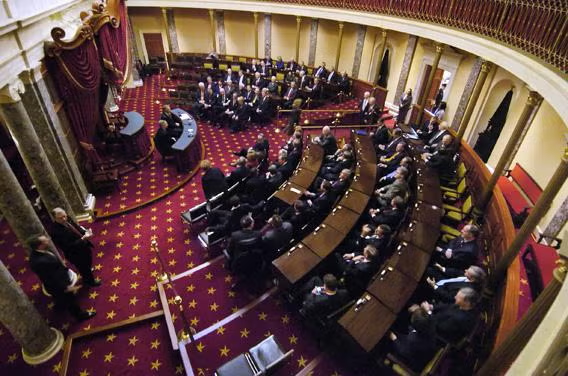
LANSING ? Michigan Senate Democrats and Republicans are clashing on whether a proposal to increase Michigan’s sales tax is the right solution to build funding for roads, and Democrats won’t back down on having a solution that includes some consideration for those with lower incomes that would be disproportionately affected by a tax increase.
In the years-long slog to increase funding for roads, Wednesday seemed to mark a new point of concern for supporters with Democrats seeming publicly uninterested in a deal and some were incredulous that the sales tax is back in the mix given the myriad problems both political and logistical associated with it.
“After three years of tax shifts onto people, there’s a big concern from people in my caucus that we need to protect people at the lower end of the socioeconomic scale who cannot afford this massive tax on gas,” Senate Minority Leader Gretchen Whitmer (D-East Lansing) said Wednesday. “So that’s the nature of our discussions, and to date, the governor has been uninterested in negotiating.”
The crux of the issue as it stands currently is whether increasing the sales tax from 6 to 7 percent, with the revenue it generates put toward roads, is a viable solution to the state’s more than $1.2 billion infrastructure problem on its own, or if it should be considered in conjunction with other proposals such as Senate Majority Leader Randy Richardville’s idea of a flat rate wholesale tax on gas or the Democrats’ idea regarding some kind of tax relief.
But the opinions vary about as much as the proposals. Richardville isn’t much a fan of doing the sales tax option alone because it requires a two-thirds vote from both chambers and voter approval in November, which is also too late to get started on any construction that is already sorely needed. And Whitmer said the opinions in her caucus on the matter vary from being “intrigued” to continuing to view the sales tax as a “regressive tax.”
“I don’t think one cent, or one percent, whatever you want to call it, is regressive. The beauty of this plan is you capture the out-of-state dollar, the out-of-state purchase,” said Sen. Jack Brandenburg (R-Harrison Township), who has been leading the charge on the sales tax proposal. “If you had to do something where you’re going to ask the people for more money, make it as less painful as possible.”
Richardville suggests instead that his wholesale tax option (his contribution to HB 5477 ) could be step one of a two-step process that includes the sales tax component.
“It would be kind of a hybrid, two-phase solution, but the first step would be let’s increase taxes at the pump now until we can fix that other part of it and start to repair and maintain the roads that we have to do now,” Richardville said.
He said voting for an increase at the pumps starting in January 2015 means the state could bond against it and start doing construction projects in the fall.
“We would say look, we understand this is one step forward that gets us a whole construction season. There may be a better way to do it. If you agree with that, we’ll change this around … That’s the structural change that the sales tax would fix.”
But it was not immediately clear how the two proposals would interact, or if they should at all.
“I’d rather have them either stand or die alone rather than overall solution, an all-or-nothing solution, because … if it falls apart, we have no solution,” Richardville said. “I’d rather have a solution and then be arguing about a better one versus nothing at all.”
And Whitmer said her caucus is open to discussing what the tax relief they seek looks like, but it needs to exist regardless. Richardville said he too is willing to negotiate on some economic or tax credit-type proposals. Brandenburg said he is open to that possibility as well, and made a pitch for a bill he introduced that would roll back the individual income tax rate (SB 402 ).
“The governor has indicated that he doesn’t want that either,” Brandenburg said of the proposal to include with the sales tax proposal his income tax rollback plan. “(Senator) David Robertson brought that up in caucus today – if we’re going to ask for this much money for roads, why not with a tax cut? I’m fully in favor of that.”
Richardville said the odds are against the Legislature being able to do something before it breaks for its summer recess, and Whitmer noted the lack of a clear solution indicates just how complex the issue is.
“The fact that (Republicans) cannot get this done shows you how tough negotiations need to be and that this is not an easy vote,” she said. “This will be, bar-none, the largest tax increase many of us will ever vote on in our legislative careers.”
This story was provided by Gongwer News Service. To subscribe, click on Gongwer.Com