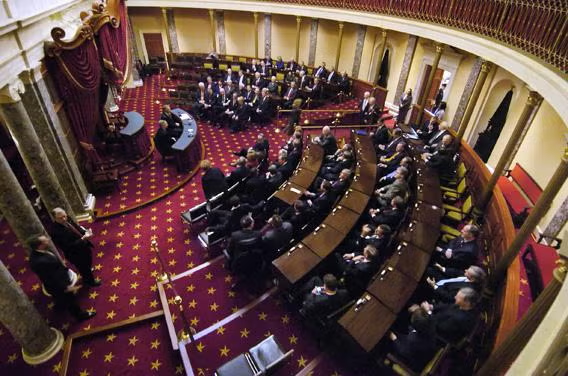
LANSING – The next four years will be more about fitting programs to people than is current practice, Governor Rick Snyder said after being sworn in for his second term Thursday.
He said the state would become a leader in encouraging students into career and technical education programs.
Snyder said he would release more details in his State of the State address next month, but he said the state’s human services systems have too many programs.
“We continued to add more and more programs on top of programs,” he said, adding that “chops people up” to fit them to the programs.
“It’s about recognizing you’re a person, you’re a human and need to be treated that way,” he said of the changes coming.
Taking the oath of office for the final time since term limits prevents him from seeking re-election, Snyder also said anyone thinking he will function like a lame duck does not know him.
The state also needs to urge more students into skilled trades as it works to improve education, he said. “Let’s lead the nation in skilled trades,” he said during his address.
“Areas we can continue to work on is prenatal through third grade reading and the intersection between high school and higher education because that’s career tech education and dual enrollment,” he said to media after the inaugural.
Snyder again called for working together with various groups as he enters his second term.
“The most important thing we’re doing in Michigan is changing our culture, how we treat one another,” he said. “Michigan’s future is about us being less divisive and more inclusive.”
Though many pundits have said incoming legislative leaders are more conservative and so could make it difficult for Snyder to move his agenda, he told media he was withholding any judgment on how well he could work with the new Legislature.
“Hopefully now with the experience I have … we can work closely together,” he said. “We may have different priorities, but we have common ground.”
Snyder said he approached his second inaugural with a different attitude.
“That inaugural personally was more exciting,” he said. “This inaugural was more rewarding.”
Snyder recounted successes of his first term, including a 40 percent cut in the unemployment rate over the last four years. “In the last four years we created 300,000 private sector jobs,” he said. “We have more work to be done but Michiganders are working again.”
Snyder also hailed the debt reduction for Detroit as it exited the largest municipal bankruptcy in the nation last month.
He also touted four years of state budgets not only balanced, but completed substantially before the beginning of the fiscal year.
To media after the event, Snyder blamed a forecast from the Senate Fiscal Agency that the General Fund could end the year in deficit on tax credits adopted under the prior administration. But he said the Senate Fiscal Agency report could also head off any discussions in the coming Legislature of reducing the income tax or providing additional credits.
“I always think it a good principal to not take a dollar if you (don’t) need a dollar, but in some cases we may need the resources to stay in a balanced fashion,” he said after the inaugural.
Of an income tax rollback, he said, “I wouldn’t put that first thing on the list that’s going to be feasible.”
Snyder did acknowledge one failure from his first term: “People still hate the roads,” he said, though adding there was an opportunity to correct that in the coming term. He would not, to media after, estimate what it would cost to promote the ballot proposal created by the last minute agreement as session ended, noting it would depend somewhat on how much opponents might spend.
But he likened the plan to the personal property tax changes voters approved on the August 2014 ballot for the type of support it might garner. Business and local government groups put substantial resources into supporting the plan, though there was also little opposition to the plan.
Lt. Governor Brian Calley, Secretary of State Ruth Johnson and Attorney General Bill Schuette all joined in the theme of improvements made and yet to come in their addresses.
“Four years ago, an entire generation had grown up knowing only a Michigan in decline,” Calley said. “We can now see a better and stronger future.”
“Michigan’s tomorrow will be better, safer and stronger,” Schuette said after calling for a moment of silence for fallen public safety officers.
Notably, though, among those he named as heroes he had worked with in the past four years were Detroit workers who faced loss of some pension benefits under the city’s bankruptcy plan.
Johnson again likened the state to auto manufacturing, “as strong as the steel used in the plants,” but redefining itself like the new technology used in those vehicles.
She praised the state for being top in the nation for getting people registered to vote, and said she would continue to improve services through her department to continue that trend, while also preventing voter fraud.
“We’ll continue our fight against fraud to stop it in its tracks,” she said.
Democrats, in a release after the address, chided Snyder for what they said were his failures that he tried to tout as successes.
“Despite claims that things are just fine, Rick Snyder’s Michigan still lags behind the national economic recovery, our state budget is running a deficit, population is lagging to the point where we could lose a Congressional seat in the next Census, the number of schools in deficit continues to grow, and Snyder’s housing agency remains mired in scandal,” the Michigan Democratic Party said in an email. “Under Snyder, Michigan only leads the nation in crumbling roads, bigotry against citizens and families because of who they are, schools in deficit, and outbound migration.”
This story was provided by Gongwer News Service. To subscribe, click on Gongwer.Com