LANSING – The Michigan Pipeline Safety Advisory Board put most of the final touches Monday on its plan to hire contractors for risk and alternatives analyses on the Line 5 pipeline under the Straits of Mackinac.
The board is hoping to issue requests for a proposal in February, said Environmental Quality Director Dan Wyant, who co-chairs the board. The board’s next meeting is in March.
Based on discussions from the board, the alternatives that contract would explore would range from leaving the pipeline as it is, to further limiting what it could carry, to shuttering it and moving the oil and gas it currently carries to other pipelines, trucks or barges.
But board members also urged language in the contract that would limit the exploration of some options.
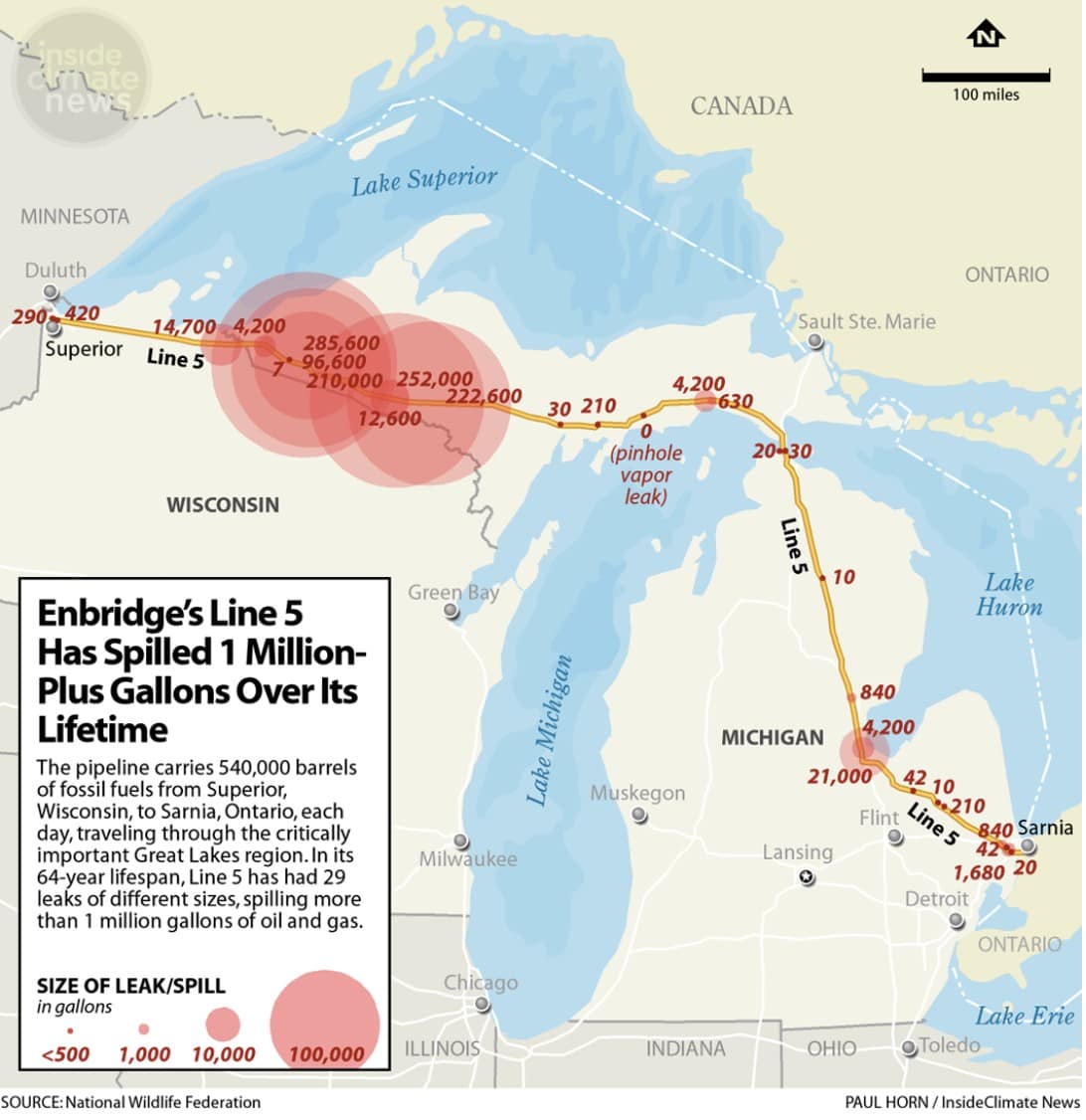
The risk assessment contractor would have to look at a worst-case spill from the line, determining how long it would take and what it would cost to clean up the spill and what short- and long-term economic and environmental damage it might cause.
There was some discussion among board members what might constitute a worst case.
Chris Kelenske with the Department of State Police emergency management services said a worst case had to look at both full ice cover and open water.
Jeff Pillon with the National Association of State Energy Officials said the risk analysis should also look at some possibilities that, while less than worst case, might be more likely and so more hazardous. “In risk analysis, that’s always part of the equation,” he said of those lesser events.
Jennifer McKay with the Tip of the Mitt Watershed Council urged for pushing the contractor beyond events for which Enbridge Energy, the owner of the pipeline, might have planned. “Typically what we see is not foreseeable,” she said of major spills.
Michael Shriberg with the National Wildlife Federation noted, for instance, that some recent training scenarios have looked at containing a spill where the line breaks and the automatic shutoffs engage. He said the worst case should look at situations where those fail-safes fail.
On the alternatives assessment, Pillon urged the board to limit exploration of some of the options. “Do we really want to go from a pipeline to barges on the Great Lakes?” he said, adding replacing the pipeline with trucks would be economically unviable.
But Shriberg said the board should look at some additional alternatives. “One of the options we have to look at is decommissioning without making it up through alternative methods,” he said, noting a proposal to that effect submitted to the board (see below).
He said it might also be reasonable to limit the pipeline to natural gas, which he said would cause less environmental damage if the line leaked.
Guy Meadows with Michigan Technological University questioned the role for public universities in the process.
“It would be hard to imagine a contractor being able to do the kind of modeling the federal government or the universities would be able to do,” he said.
Mr. Wyant said the process would be open for universities either to bid on the project or to act as subcontractors to the bidder.
There was also some interest among board members to conduct a pre-bid conference and for board members to be involved in that to allow them to interact with potential bidders and clarify some of the questions raised Monday.
Some board members also appeared interested in increasing the meeting schedule from the current quarterly dates rather than developing subcommittees and potentially losing some member’s expertise on an issue.
Carol Isaacs, chief deputy attorney general, urged the board members to submit any studies or reports on the issues they felt might contribute to the discussions.
“We are going to need a body of credible evidence,” Isaacs said.
ALTERNATIVE PLAN: The environmental group For the Love of Water released its own report Monday arguing that the best alternative was to close the pipeline under the Straits. The oil that flowed through Line 5 could be shunted to Line 6B, which runs through Wisconsin to Chicago and then east to Detroit, the group said.
The western line was rebuilt since it burst and spilled oil into the Kalamazoo River and can carry substantially more product, the group said.
“Decommissioning Line 5 in the Great Lakes would not disrupt Michigan’s oil and propane supply,” Liz Kirkwood, executive director of FLOW, said at a media roundtable before the board meeting. “Enbridge effectively built its own version of the now-rejected Keystone Pipeline.”
The group’s report said Enbridge could still use the portion of Line 5 remaining in the Upper Peninsula to deliver the natural gas to the propane refinery in Rapid River.
The group urged the board to recommend that the line be closed under the Straits until the board makes its final recommendations, likely sometime next year.
Enbridge spokesperson Jason Manshum said he had not seen the FLOW report, but said it was, at this point, just that group’s opinion.
Manshum said the company’s focus is on helping the board find the right contractors to assess potential options and risks.
“We wouldn’t operate Line 5 if we didn’t think it was safe and reliable,” he said.
This story was published by Gongwer News Service. To subscribe, click on www.gongwer.com