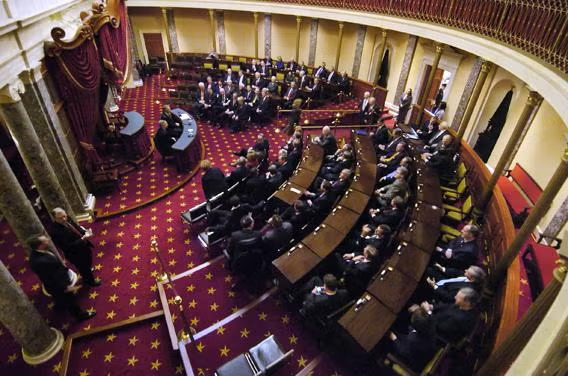
LANSING – Senate Majority Leader Arlan Meekhof on Tuesday confirmed the end of several controversial initiatives passed by the Michigan House last week on a day otherwise consumed with recesses and caucuses.
Among those proposals was a bill to tighten up voter identification (HB 6067), bills regulating picketing and striking workers (HB 4643 and HB 4630) and legislation to open up the governor’s office to the Freedom of Information Act and apply public records law to the Legislature (HB 5469, HB 5470, HB 5471, B 5472, HB 5473, HB 5474, HB 5475, HB 5476, HB 5477 and HB 5478).
“We intend to have that discussion some time about secure-reason AV and all those types of things, but probably not in these three days,” Mr. Meekhof (R-West Olive) told reporters Tuesday as his chamber recessed for more than five hours before noon. “We haven’t done real well in the courts on election law so we want to make sure that if we do something, we’re able to march right through.”
The Metro Detroit AFL-CIO welcomed the development.
“Stopping these Republican voter suppression bills is a big win for democracy,” President Rick Blocker said in a statement. “This legislation is utterly shameful and downright discriminatory. (The) bills were specifically written to rig the system for Republicans by making it harder for senior citizens and people of color to vote in Michigan elections. That’s just plain wrong, and it’s downright un-American.”
As to the House public records bills, Meekhof there was still “a lot of work to do on those.” He said his caucus posed several questions on the bills the House “hadn’t anticipated,” and so they too would be shelved.
Rep. Jeremy Moss (D-Southfield), who worked on the FOIA proposal with Rep. Ed McBroom (R-Vulcan), said he was disappointed the Senate was not taking up the legislation. Moss said the bills passed with little opposition in the House and he had not heard of any concerns from the Senate.
“I haven’t heard any of this concerns or problems. So I would love to talk to him about it,” Moss said of Meekhof. “These passed with overwhelming majorities. … I am willing to sit down and go line by line the legislation with him. Because it did win that really nonpartisan support for something that is so glaringly missing in the House and the Senate and the governor’s office.”
Moss said he has already talked to Rep. Lee Chatfield (R-Levering), who sponsored a bill in the FOIA package, and will be serving in leadership next term to start the process with legislation right away next term.
“Hopefully if we start earlier, and are able to get a vast amount of support for it, we can move forward and hopefully see its passage next term,” Moss said.
Meekhof was still adamant about a bill codifying the federal Citizens United decision on campaign contributions, SB 638. The bill, Craig Mauger of the Michigan Campaign Finance Network has said, also would broaden the definition of what an independent committee is to allow greater connections between a candidate and the ostensibly independent committee.
“If there’s pressing things that are important for the people of Michigan, we may do those in these last three days,” he said. “But our members have the rest of next year, two years, to work on their priorities.”
On whether any bills mentioned in the Flint joint committee report might have a chance at being taken up, Meekhof said, “They’re not in our bushel basket right now, but there’s stuff there that still needs to be enacted.”
He reiterated: “The speaker and I have made an agreement: All the stuff that’s in front of us, that people have made priorities, we’re going to keep all that stuff in a basket, and anything else has to be put on the agenda.”
This story was published by Gongwer News Service. To subscribe, click on www.gongwer.com