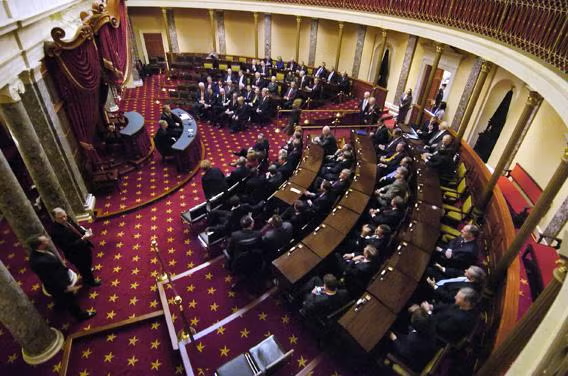
LANSING – The Michigan House
Insurance Committee put its stamp on the fast-moving auto insurance
legislation Thursday by approving a bill with a more specific fee
schedule and a mandated $100 per vehicle rate rollback.
SB 248 and SB 249 were sent to the full House 9-6 with all Democrats
voting no following seven hours of committee testimony this week.
Republicans, Rep. Michael Webber of Rochester Hills and Rep. Jim
Runestad, of White Lake Township, abstained.
Changes in a substitute included a specific fee schedule with a
reimbursement rate at 150 percent of the Medicare rate and a requirement
for auto insurers to reduce rates by $100 per vehicle in the first two
years. Immediately hospitals and other supporters of the current system
denounced the fee schedule as unworkable and financially ruinous.
Rep. Tom Leonard III (R-DeWitt), chair of the committee, called the
changes in the SB 248 a step in the right direction. Leonard said he is
willing to work with anybody interested in the issue moving forward.
anybody who wants to be a part of the solution on this,” he said. “I am
going to be on the phone a lot over the weekend.”
Rep. Tom Barrett (R-Potterville), sponsor of the substitute, said
although the rate rollback is only guaranteed for two years, an increase
in competition is expected after those first two years, which will lead
to better rates.
statement that the group is disappointed in the bill the House committee
reported. “The fee schedule in this bill is completely unworkable from a health
care provider standpoint,” he said. “Without question, the reimbursement
structure of SB 248 will cost hospitals tens of millions dollars each.
This is not a scare tactic. If SB 248 passes as is, trauma centers will
be threatened in every area of the state. From that standpoint alone,
this bill is irresponsible.”
group is encouraged to see the House acting with conviction on getting
the bill to Governor Rick Snyder. “We’re pleased that the House is moving forward and looking for
solutions of high prices of no fault without reducing benefits,” he
said.
worker’s compensation (as the Senate committee originally proposed but
then revised), but he expects more changes to be made to the bill before
it is passed. On the rate rollback, Shields said insurers can’t predict
what conditions would be like in the future, but the coalition is still
encouraged by the Legislature having the discussion.
substitute, but most failed. One amendment offered by Rep. Tom Cochran
(D-Mason), minority vice chair of the committee, would have removed the
$15 per hour limit on attendant care provided by family members.
He also offered a series of amendments that would require rate rollbacks of 10, 20, 30 and 40 percent, all of which failed.
Later Cochran blasted the bill in a statement, saying he is disappointed
at the speed the bill is moving through the Legislature.
reduce pay for medical professionals and ultimately leave victims of
catastrophic accidents with fewer options and higher bills,” Cochran
said. “The proposal, which is supposed to reduce the cost of insurance,
does not even provide guaranteed rate savings for consumers. Quite
simply, these bills are bad policy, and my Democratic colleagues and I
will fight them every step of the way.”
care limits would not apply to family members who received training and
were professional home health caregivers.
Leonard said the amendments offered by Democrats came late and were not
able to be fully vetted, though similar amendments could end up in the
final bill.
anybody on any amendment,” he said. “Most of the amendments offered
today were not able to be properly vetted. … Many of the amendments
voted on today, they very well could be amendments offered on the floor,
but we need time to vet all of those.”
failed, would have removed the $150,000 appropriation in the bill.
Opponents have charged the appropriation is there only to make the law
referendum-proof.
Asked if the appropriation was needed, Leonard said the provisions in
the bill need to be implemented and it is needed. When asked why the
appropriation couldn’t be inserted into the budget, which hasn’t been
finalized by the Legislature, Leonard said: “That will certainly be
discussed.”
levels and ZIP codes as ways for auto insurers to set a person’s rates
also failed.
Otherwise, the bills phase out the Michigan Catastrophic Claims
Association, replacing it with a new agency under state oversight, and
establish a fraud authority partially funded by insurers.
CPAN also blasted the fraud portion of SB 248, saying it only considers fraud perpetuated by claimants.
companies are denying care for injured people based on falsified
information and fraudulent practices,” Cornack said. “That is just as
fraudulent as someone who files a false claim, yet this committee chose
to do nothing.”
the no-fault legislation was originally passed, it was to ensure those
who are catastrophically injured received proper care. He urged the
committee to take more time to review the legislation before acting.
But Wendy Block with the Michigan Chamber of Commerce said the bills
would attract new companies to write insurance in the state, and that
would lead to even lower rates with more competition.
In a statement, the Michigan Health and Hospital Association said the bill would be devastating.
Bill 248 which would slash hospital reimbursement and eliminate
guaranteed benefits for accident victims, while providing no permanent,
guaranteed reductions in auto insurance premiums for drivers,” the group
said. “This threatens hospitals’ ability to sustain current levels of
service and endangers access to care for ALL patients, not just auto
accident victims.”
Sen. Joe Hune (R-Whitmore Lake), sponsor of the bill, said they will
discuss some of the changes the House committee made in the coming days. “I’m supportive of getting it accomplished and getting it across the
finish line,” Hune said, adding that there may be another caucus
discussion needed on the changes.
Meekhof agreed, saying he will be talking with caucus members. But he is
unsure on the specific fee schedule rather than the more generic one
the full Senate adopted because his caucus supports market-driven
results generally. “People have to compete or bargain for (those reimbursements),” he said. “The market would have to make those decisions.”
As to the rate rollback, Meekhof said that wasn’t something the caucus started out thinking about much at all.
look at it in the same light as (the House) did on that item.”
As to how soon caucus discussions might begin, Meekhof said he and Hune
would like the House to finish their work first, including passage on
the House floor.