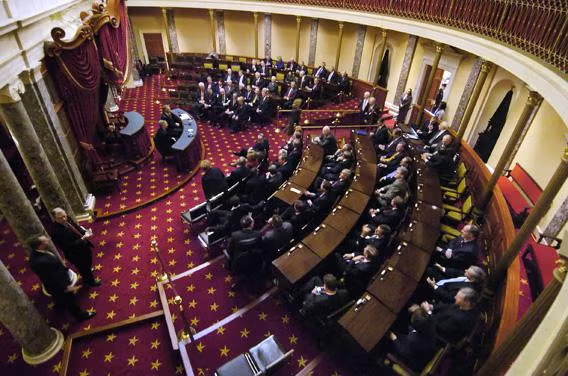
LANSING – As the Michigan House
Energy Committee continues to consider legislation modifying the state’s energy
policy, the committee heard testimony on Thursday about the renewable portfolio
standard and how in current form, the bills would not increase the renewable
mandate.
Those supporting an increase in how
much power utilities must generate from renewable sources said increasing
renewable energy has brought jobs to the state. The legislation in question, HB
4297 , maintains the current mandate that 10 percent of energy
generated by utilities must come from renewable sources.
James Clift with the Michigan
Environmental Council told the committee there should be an increase in the
commitment to renewable energy, and the Sierra Club Michigan Chapter suggested
the renewable mandate be increased to 30 percent by 2030. Enacting HB 4297
would “contribute to more climate disasters,” the Sierra Club said.
The plan in front of the committee
comes from Rep.
Aric Nesbitt (R-Lawton), the committee chair who has said renewables make
sense in the current market and will continue to play without a mandate.
James Ault with the Michigan
Electric and Gas Association said without an increased mandate, utilities will
be able to tailor renewable energy in a way that works for them and will be
able to better deal with rules coming down from the federal government.
David Harwood, director of Renewable
Energy for DTE Energy, agreed. He said because of rules from the federal
government, utilities will be moving forward with renewable energy and energy
efficiency without a state mandate.
“The feeling is if states put
additional mandates on, it takes away from flexibility on how to deal with
federal rule, (and) we will end up with a program that costs more than it
should,” Harwood told Gongwer News Service. “The mandate removes
ability for you to take advantage of market advantages as they occur.”
Clift said the legislation should
illustrate goals moving forward. He said one of those goals should be
controlling costs for residential customers.
He also said renewable energy would
help control those costs.
“We need to focus on strategies
that bring down costs for everybody,” he said.
But, Craig Borr, president of the
Michigan Electric Co-Op Association, said the current law has done what it
intended to do. He said it has jump started clean energy usage in the state.
Like other utilities, he said
renewable energy will continue to be utilized without a mandate, but that
flexibility is needed.
This story was published in Gongwer
News Service. To subscribe, click on www.gongwer.com