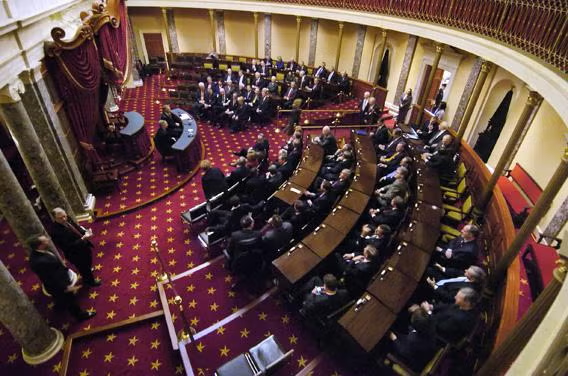
LANSING – Michigan House Speaker Kevin Cotter, joined by much of his
caucus, announced a plan on Wednesday generating $1.05 billion for roads with
only $45 million coming from new revenue. His plan would instead eliminate the
Earned Income Tax Credit, reprioritize statutorily restricted funds and
dedicate more General Fund dollars.
The full $1.05 billion would be
phased in, and wouldn’t fully be realized until 2019. The plan dedicates $700
million in General Fund dollars to roads as well as $185 in redirecting
restricted funds and $162 million in tax fairness.
The plan comes about a week after
voters said no to Proposal 15-1 with historic margins. The proposal would have
restored the EITC to pre-2011 levels.
Cotter (R-Mount Pleasant) said he
views the tax credit as taking money from one taxpayer and giving it to
another. He said taking the $117 million and using it for roads instead is a
better option.
Rep. Brandon Dillon (D-Grand Rapids), a member of
the House Appropriations Committee, said the plan as a whole was laughable and
he was unsurprisingly not supportive of eliminating the EITC.
“I think it would have a real
devastating effect on people who rely on the small amount of money they get
back every year for car repairs, grocery bills, other urgent needs,” Dillon
said of the EITC elimination. “These are working poor people. These aren’t
people collecting welfare. – I think it’s really un-conservative to take away
an incentive for people to continue working even though they’re doing so for
such low wages.”
About $45 million would be generated
as part of the fuel tax fairness piece. It would create diesel
parity bringing the tax to 19 cents per gallon, and index fuel taxes to
inflation. There would also be some sort of fee for electric or hybrid vehicles.
Cotter said the funding would be
dedicated to roads from the General Fund no matter what happens with economic
growth, though it is expected the economy will grow.
Dillon said, however, with added
pressures to the budget coming in the future, including the state having a $9
billion liability from old tax credits and eventually having to pay toward the
Medicaid expansion, it’s not possible without making major cuts.
Cotter disagreed, saying the state
will undoubtedly face budget challenges in the future, but the dedication is
realistic.
“I feel strongly that even when
we have those challenges, roads need to be a priority,” he said.
House Minority Leader Tim Greimel (D-Auburn Hills) said
Cotter’s plan won’t guarantee future road maintenance or repair.
“Relying on imagined future
revenue growth is not a long-term solution that will take us into the future
with a solid financial plan to fix and maintain our roads,” Greimel said
in a statement. “Raising taxes on working families by eliminating the
Earned Income Tax Credit, while not asking corporations who’ve seen billions of
dollars in tax cuts to make a contribution, is a slap in the face to Michigan
residents.”
Another piece is re-prioritized
restricted funds. Included in the plan is $75 million from the tobacco
settlement in the 21st Century Jobs Fund, $60 million from the tribal gaming
compact and $50 million from ending the film subsidies program.
Cotter said he has not talked to the
Saginaw Chippewa Indian Tribe in his district about this plan, though he said
he does not expect any opposition, as the funds are currently used for economic
development.
Having good roads is a prerequisite
to economic development, he said, adding having roads that look like a bomb
just went off is not an incentive to get businesses to move to the state.
The plan relies mostly on General
Fund dollars, with $700 million eventually being directed to roads. Cotter said
future growth, including “extra revenue” at the consensus revenue
estimating conference this week, and the Legislature’s will to make roads a
priority will make the General Fund contribution possible.
House Appropriations Committee ChairRep. Al Pscholka (R-Stevensville) said getting to
$700 million from the General Fund is doable. He also said the numbers used in
the plan are conservative and the budget will likely go beyond what it calls
for in the current budget.
Pscholka also said the plan proposed
on Wednesday would get more money to roads faster than Proposal 1, though he
noted Tuesday’s plan would not pay down any bond debt as Proposal 1 would have
done.
Pscholka said in the current budget
$160 million has already been directed to roads from the General Fund, and he
expects $140 million more the budget currently under discussion. He said the
plan then goes up to $350 million in 2017 and a little more than $500 million in
2018 before reaching the full $700 million in 2019.
“I think this a good first
step. I think this a good starting place,” he said. “I think the
House is saying we are going to do whatever we can to get the money from
resources we already have.”
The plan would require the
Department of Transportation and local road agencies to competitively bidding
projects costing more than $100,000, better use warranties and allow townships
contributing more than 50 percent to a project costing more than $50,000 to require
competitive bidding.
Cotter said he would like to see
bills considered in committee and then on the floor in a matter of weeks. He
said currently roads and the budget will be center stage.
The Senate has already planned for a
summer session to deal with road funding. Cotter said the House is currently
scheduled until the end of June. He said he hopes to get the work finished in
the next six weeks, but if not, he would look at staying longer.
Cotter acknowledged the House and
Senate were rather far apart in road funding plans last term.
“Things have happened since
that point in time. Not only have we had changes in each of the bodies, but we
also have had a change in circumstances,” he said. “I want to start
that conversation again and I see this as a first step in that.”
Cotter said the House has to be a
good partner in ongoing road talks and is not taking anything off the table,
including a larger tax increase.
The Michigan League for Public
Policy said in a statement restoring the Earned Income Tax Credit should be a
priority for everyone in the Legislature, and it should not be eliminated.
“This proposal is our greatest
fear: it eliminates one of the few tax credits helping to bring low-wage
workers out of poverty and paves the roads on the backs of our most vulnerable
people,” Karen Holcomb-Merrill, vice president of the group, said. “Eliminating the Earned Income Tax Credit is the wrong direction. Because
of the regressive nature of sales taxes, we fought hard for Proposal 1 to
restore the EITC from the current 6 percent to 20 percent. It would have
protected the lowest earners, those making less than $20,000 a year, from the
increased sales and gas taxes and registration fee changes. For a single mom
supporting two kids on a full-time minimum wage job, that would have meant an
extra $608 to buy food and pay bills, or maybe get ahead a little for
once.”
Michigan Economic Development
Corporation CEO Steve Arwood said in a statement he is still
reviewing the proposal, but fears it would jeopardize from economic development
programs in the state. He said he is looking forward to seeing what changes are
made moving forward.
“We are currently reviewing the
budget plan presented earlier today by the House leadership. While we
understand that roads are an important issue to the state, this reduction in
FY16 funding severely limits the state’s ability to have an economic development
strategy moving forward,” Arwood said. “Furthermore, it threatens to
eliminate the entire Pure Michigan tourism effort – an industry which supports
214,333 jobs in our state.”